Conscious Contact

I still bristle when someone sends me a message on social media that tells me that God is blessing me this day, or that Jesus holds me in his arms. It brings back a past of rules, laws and feelings of guilt and shame. I am grateful for all I learned about religion and its practice but it is not my way of approaching my Higher Power now. There’s nothing wrong with the message. I hope to receive the blessings of my Higher Power and to feel the comfort of the Energy that surrounds and sustains us.

It’s the word God that bothers me, though I still say it. I use the word because it’s easier than explaining my concept of Higher Power. I use the word God and everyone understands that I am talking about something that is more than just me. At the same time, I would prefer that we had another word in English that conveys this concept. The image of an white haired, bearded man perched on a throne in a cloud is no longer my idea of what Source Consciousness is.

I am grateful that my recovery program allows me to choose my own concept of a Higher Power. It was a great relief when I came into the room that it wasn’t full of bible thumping proselytizers who were going to save me. I was able to find a ‘God of my own understanding’. This concept, though I didn’t understand it at the time, gave me an opening into developing a new and very different understanding of connecting to a power that had always been part of my life and brought me to recovery.

aerial photography of river

Photo by Elena Zhuravleva on Pexels.com

I have pretty much given up on trying to define exactly what my Higher Power is. I believe that defining that power will limit it. It’s enough to know it’s here with me. What does continue to change as I live my program is my understanding of that Power. By looking at the faiths of the world and different spiritual practices, I am deepening in my knowledge of how everything seems to work and I am left awed and amazed at how everything fits together. One of the gifts of my past is through it I can follow how the events that happened along the twists and valleys of my path have brought me to where and who I am today. Sometimes, even as things are happening and circumstances are changing, I take a step back and wonder how all of it is going to fit together, because it will. It always does.

The Eleventh Step invites me to improve my conscious contact with this Power by means of prayer and mediation, talking and listening, seeking and reflecting. I open my day by sitting on the terrace and watch the growing light as it illuminates the trees that surround me and enjoy the birds and other creatures passing by. It’s a wonderful way to open to gratitude first thing in the morning. It might not be traditional meditation but it’s working for me at this time. I expect that in the future, as my understanding of this Higher Power grows, how I keep in consciously contact with that Power will also grow. Today I receive the gift and feel the peace of knowing that I am not alone. I am grateful. pexels-photo-312839.jpeg

Promptly Admitted It

Before we leave off the tenth month and the Tenth Step reflections, I was reminded by a group member of a very important point in Step Ten: “…and when we were wrong, promptly admitted it”. It’s not just a case of offering an apology and moving on. I must offer amends to the person that I have offended. The difference between the two isn’t so subtle.

The Apology:

An apology is a heartfelt ‘I’m sorry’ for what I did or failed to do. A true apology doesn’t make excuses or explain circumstances. Rather, it is an admission of my failure to act as I should have acted. For all its heartfelt emotion, an apology end there. There is a hope for forgiveness, but it is not necessary. I’ve done my part; it’s up to the other person if he wishes to accept the apology or not.

The Compensation:

blur cash close up dollars

Photo by Burst on Pexels.com

There are three elements to making amends. First, an amends should begin with a sincere apology. Secondly, it should also includes some form of compensation to make up for what was done. The repentant thief asks for forgiveness for what he stole and offers to pay back what he stole plus some extra compensation, perhaps interest earned or some agreed upon terms of recompense to make up for what was taken.  It might include repair or replacement of broken or damaged items. It is a demonstration of remorse for what was done.

Perhaps when it’s something physically tangible it´s easier to make amends: return the money, give back the car, pay for a new window. When it’s something intangible then it is more difficult to make amends. How do I make amends for taking away someone’s peace of mind, abandoning them, or ruining a relationship? Reparation for damages isn’t quite as cut and dried here. Some discussion might be necessary to resolve the terms and nature of the amends.

The Commitment to Change:

bear beautiful bloom blooming

Photo by energepic.com on Pexels.com

A beautiful bouquet offered after a heated argument might be enough the first time, but if the pattern continues, the person making the amends might just get a facefull of flowers after the third or fourth time. That because part of amends also includes the idea that one’s behaviour has been amended or changed so that it won’t happen again in the future. A boss might be willing to accept the amends of an employee who abuses his expense account the first couple of times, but no matter how sincere or honest the apology is after the third screw up, it’s likely not going to be accepted because it’s obvious the behaviour hasn’t changed. So the third element in amends has to be a commitment to change, that I won’t do the same thing in the future. Amends involves a change in life patterns and behaviours. This is ‘living’ your amends.

I have times when I am more successful than others with making amends. I sometimes slip back into old patterns of thinking and acting. I try not to focus on these times as much as I look to the times when I’ve earned a checkmark in life. I recently read that it’s better to: ‘look to the gains, not the gaps’. If I focus on my program I am going to make some incredible wins. One way of doing that is by getting over the screw-ups as quickly as possible: apologise, compensate and change are the three elements of this amends. Making amends is an incredible life win; I have done what is under my control to make up for the offence. And I can move on with my day, celebrating my gains and living my recovery.


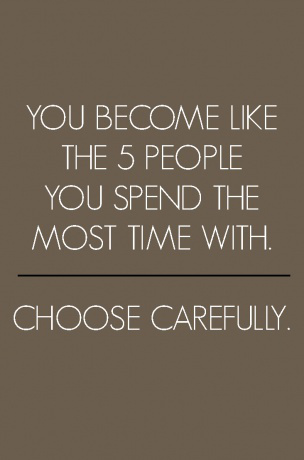
Who Are Your Friends?

There’s the old say: you are what you eat.  It makes sense, if you eat garbage you can’t expect to have the body of an olympic athlete.  The movie “Supersize Me” demonstrated just how quickly that change can take place.  There’s also another truism:

“Show me your friends and I’ll show you your future”  -Dan Pena

Hanging around with the same five or six people will keep all of you at the lowest common denominator in terms of interests, pursuits and goals. If I try to improve myself, those friends of mine will often, unconsciously and without malice, hold me back from reaching new goals. I do it to myself as well: I wonder what the ‘group’ will think if I do this? By the time I hit bottom in my addiction, I was mostly hanging out with others who used the way I used. If I was going to survive and recover, I needed to get away from that environment.

There was a study done years ago on fleas.  A bunch of fleas were put into a jar and the lid was put on.  After a few days of bumping their heads, the fleas learned to jump only as high as just below the lid of the jar. When the lid was removed, these fleas didn’t jump out of the jar.  They stayed at their level because the believed they couldn’t jump higher than they were jumping. Even subsequent generations of fleas only jumped as high as their parents because well, that’s only as high as fleas jump.  However, if you took one of the fleas from this jar and put it into another jar where the fleas were jumping twice as high, it didn’t take long before the flea learned to go far beyond its former limit.

day242The message for us is very similar. If we stay in an environment where limits are put upon us by social pressures and our own beliefs then making permanent changes in our lives is very difficult. For those of us in recovery, making the choice to be clean and sober is often regarded with skepticism by those we hung around with. It’s important in the beginning to seek out others in recovery to help us and encourage us to move forward. We don’t necessarily drop our old friend, but we spend less time with them. Our common interests are changing. As we move forward in our recovery, they may see the results and want the same, or not. Ours is a program of attraction; it can’t be sold.

I have little in common with those who are still in their disease. I hope someday they will receive their own gift of desperation and find recovery.  I will gladly help in whatever way I can but it’s up to them. I am grateful for my friends in recovery. It’s a very different group of people from my old group. And they continue to assist and challenge me in my recovery. They help me soar in my recovery, showing me that I can not only jump, I can fly, higher than I ever thought was possible.