You Have the Power!

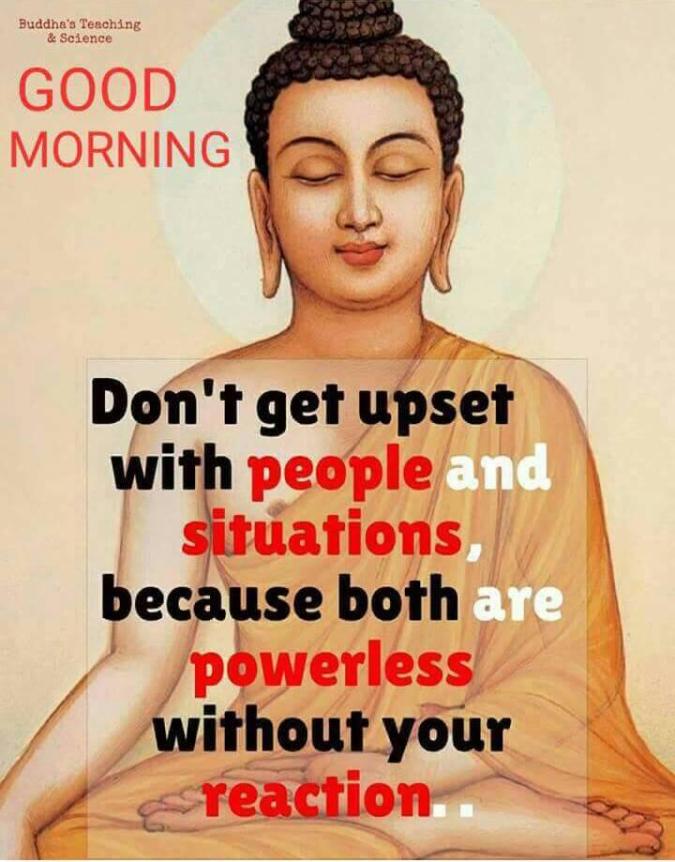
“Don’t get upset with people and situations because both are powerless without your reaction.”

I came across this quote this week. There was a picture of Buddha with it, but I have no idea if it is a Buddhist quote. If I don’t react to things around me, then I don’t give them my power. It goes along with acceptance. It about how I invest my emotions in the things that around me. When I accept something, I am saying that it is. Nothing more. I am not saying that I like it. I am not saying that it needs to be changed. I am outside of that judgment. It simply is.

My emotional involvement in people or situations will not change anything. Getting angry with another driver for cutting me off will not change anything.  The other guy might not have realized that he did what he did.  He may wonder why some freak in the car behind him is blowing his horn and blinking his lights. He probably can’t hear your shouting and can’t count how many fingers you have pointed into the air. If I accept that the guy cut me off then I am not giving him power, nor am I giving my power to what he did. If I learn to remain calm, and accept, I keep my power and I keep my serenity.

Acceptance does not equal approval.

Acceptance is separate from judgement. I don’t have to like what is happening when I accept it. I am simply acknowledging that it is. I don’t like it when people treat me with disrespect. I don’t like it when I’m cut off in traffic. It bothers me when my efforts go unnoticed or unappreciated. I can still accept that it happened and then make a decision about what to do or not do about it. I don’t have to give away my peace of mind, my serenity when it happens. I have the ability to choose where and how I express my emotions. Another person cannot piss me off unless I let him.

I can’t control people, places or things.

My circle of control extends to about as wide as I can stretch my arms and sometimes it contracts about as far as the tip of my nose. If I am angry or upset or frustrated about something, it is because I have allowed that to happen. You didn’t do it to me, the event didn’t do it to me. I did it to me. That’s a hard pill to swallow at first. My immediate reaction is to lash out. But like everything else, it is a process. First I see that I lashed out when something happened. With some more practice I then recognize it when I am in the midst of it and finally I stop myself before I lash out at someone because I do not want to give my power to them. It’s not a straight line process either; sometimes I am in acceptance and sometimes I jump right to anger.

“…Sometimes quickly, sometimes slowly…” Working on our reactions and turning them into responses that are thought out takes time. Trust the process. Trust your ability to make a change. Nothing is impossible.

Peace.
23795716_10215086809028702_9094509652038181971_n

Stop and Think

I’ve known my friend Barb and her husband Alan for over twenty years. Recently Barb has been dealing with a condition that is limiting and painful. As a result, she started take a pain management class. One of the great things she took away from the class is Stop and Think. “If you take nothing else from this class,” the instructor said, “that will get you through so much. And if you don’t take that in, nothing else I tell you will help.” Oh what a simple lesson, yet so often forgotten.

Stop and think reminds me of a safety lesson from grade school oh so many years ago. If you ever find your clothing on fire don’t run, rather, Stop, Drop and Roll. I’m pretty sure that we can apply this here because so often whenever we run into difficulties, we run around like the proverbial headless chicken. Stop, drop and think! I have the urge to do something to make things right and better. I want to help and do. However, I don’t always think my solutions through and often react by doing the same thing I did the last time I had this problem, which, obviously didn’t solve the problem because here I am trying to solve it again. Stop and think. I’ve come to the conclusion lately that ‘common sense’ isn’t all that common at all. There are a lot of folks out there in the world going off half-cocked doing and saying things that, if they had stopped, sat down and thought about it, wouldn’t have done or said.

In my recovery program, it is extremely important that I stop and think. At first it is difficult. It seems so easy to go to my angry place because of what my partner did. It is easier to slip into self-pity than to stop and think about the situation. The pill bottle or the liquor bottle will help out. I try the ‘easier, softer’ solution rather than stopping and thinking about what I am doing. We are breaking a habit that has been practiced for years. So the idea of stopping and thinking is new. And I must stop and think I can ask myself what’s the next ‘right’ thing that I need to do?

It’s not easy at first. I have neither the tools nor the experience to have any idea of what the ‘right’ thing to do is in this situation. Stop and Think Tim. I can talk to my sponsor or other addict about it. I can (and so often still do) say the Serenity Prayer to help calm and focus my thoughts. I can learn to play the tape through to the end, envisioning the results. In the process of my thinking about it, the answers came.

Sometimes the best thing about stopping and thinking is the realization that I don’t have to ‘do’ anything about this. So much of what was happening around me wasn’t my problem. I didn’t have to fix anything because it was never up to me to fix it. And other times when I trying to solve a problem it dawns on me that it isn’t a problem to be solved, rather, it’s a fact that must be accepted.

Stop and Think! At first, like any other habit that we are trying to cultivate, it is awkward and doesn’t feel right. Give yourself time. Gradually we learn how to apply the steps to our lives. I learn to do the ‘next right thing’, it doesn’t automatically happen because I’m now clean and sober. A drug or a drink will give me another problem on top of the original one. Stop and Think! because if you don’t get this, nothing else in the program will work.

Thank you for your thoughts Barb.  Check out her blog post here.

Sharing Solutions

I was talking to a friend yesterday who is in recovery. She mentioned that she goes to very few meetings. Why? Because her home group meetings tend to focus on the using stories, you know, the war stories, the drunk-a-logs, the remember whens. It’s often a negative experience for her. Unfortunately there aren’t many options for her in her town and not having a vehicle, it’s difficult to get to other places where meetings aren’t always looking at the problem.

I am grateful that my home group has good recovery. We read that we don’t need to regret the past or shut the door on it, but rather, learn from it and apply it to our lives today. And yes, there are days when there seems to be a table full of members complaining about their problems with relationships, neighbours or finances, but the sharing somehow always comes back to living in the solution.

How does the group achieve this? I believe that it is taught by continued good sponsorship. When I was young in the program, I think I had maybe three or four months of being clean and sober, I became very aware. Now that substances weren’t clouding my judgement, I could see my defects and deficiencies. As they say, a horse thief who isn’t drinking is still a horse thief. I was beginning to see who I really was. I used a meeting to complain about the program, the pace of my recovery, my fears and worries. I can see now that I was focusing in on my problems at the meeting.

Fortunately for me, after the meeting, an old-timer asked me, “Do you have a sponsor?” I was rather taken aback by his directness, but replied that I did. “Then I suggest you use him,” he advised. Fortunately I was willing to listen to this advice and learned a valuable lesson: Bring your problems to your sponsor and your solutions to the meetings.

Yes, it’s important that meetings are places where one can go and vent about what is going on in ones life, but I don’t think my friend is wrong in her assessment of her local meeting. We need to hear solutions. We all know the problems but we often have difficulty, especially in early recovery, in using our program and applying solutions to those problems. That’s what I need to hear. I don’t want to hear about your problems at home, I need to hear about how I can apply the program in creating solutions. We all have an irritating coworker or someone who cuts us off on the road, but tell me how you are finding serenity in the midst of it all. I don’t need sympathy and compassion, I need to know how you managed a similar situation. My sponsor or the person beside me might share a new perspective or idea from their experience, strength and hope.

I get those solutions from working my twelve step program with my sponsor and by having these same people sharing around the table. I get the solutions because we have a policy of no cross-talk: no giving direct advice to a person. Rather than commiserating with the person or telling them what they should do, we share how we dealt with people, places, things and events that happened in our lives. I get the program because sponsorship is encouraged and promoted. That for me is the program in action, and in action in a very positive way. If you’re not hearing solutions at meetings, perhaps it’s time to look for another home group. There’s a lid for every pot; find look for one that fits you well.